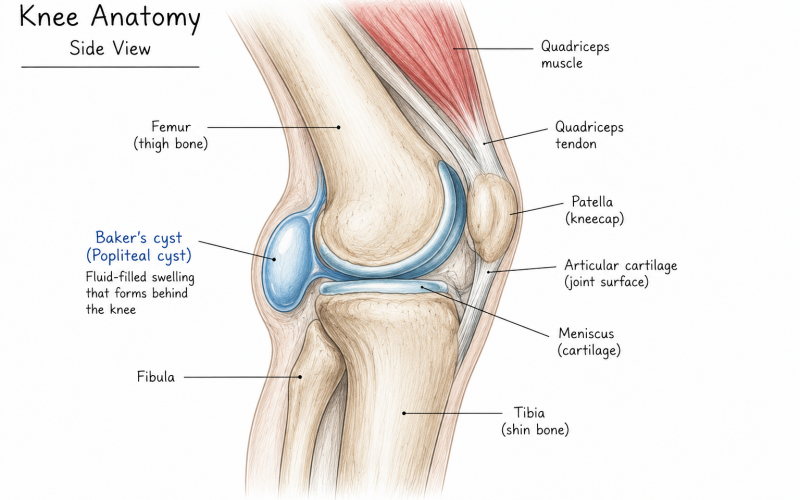
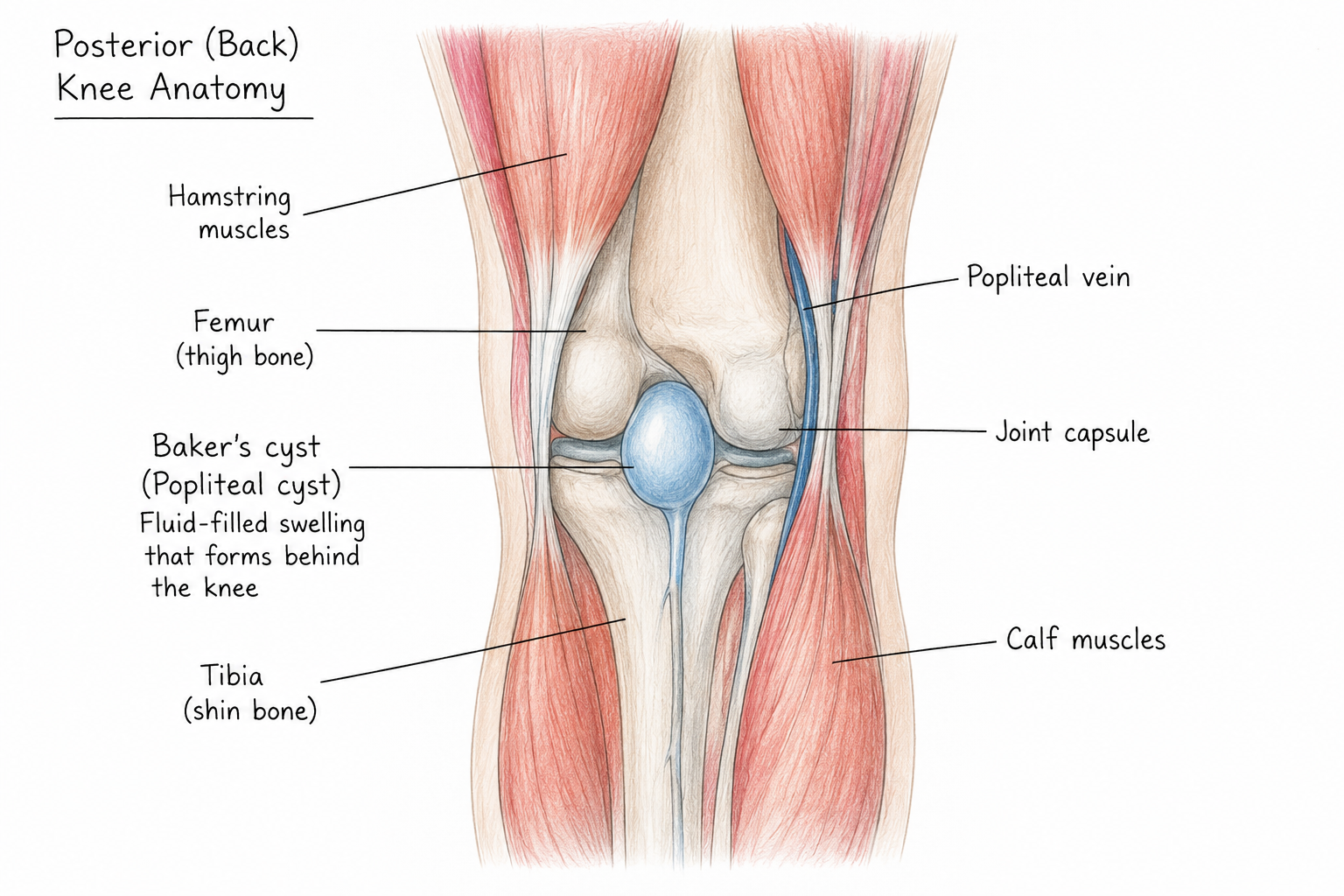
Have you noticed a swelling behind your knee that wasn’t there before? A Baker’s cyst, sometimes called a popliteal cyst, is one possible explanation.
In many cases, it’s less a condition in its own right and more a sign that the knee is reacting to something happening elsewhere within the joint.
You might notice a lump behind the knee, a feeling of tightness when you bend or straighten the leg, or simply that the knee doesn’t move as freely as it used to.
One thing that surprises many people is that the cyst itself often isn’t the main problem. More often, it’s a sign that the knee is irritated and producing extra fluid.
Understanding why that has happened is usually more important than focusing solely on the cyst.
What does it feel like?
Everyone experiences it a little differently, but common symptoms include:
- Swelling or a lump behind the knee
- Tightness at the back of the knee
- Difficulty fully bending or straightening the leg
- Aching around the knee or upper calf
- Stiffness that becomes more noticeable after activity
Some Baker’s cysts cause very little trouble. Others can make everyday activities such as walking, squatting, kneeling, or climbing stairs uncomfortable.
Why do Baker’s cysts develop?
Inside the knee is a fluid called synovial fluid. Think of it as the joint’s natural lubricant. It helps the knee move smoothly and keeps the tissues within the joint healthy.
When the knee becomes irritated, it often produces more fluid than usual. Sometimes that extra fluid collects at the back of the knee, creating the swelling we call a Baker’s cyst.
Common reasons this can happen include:
- Osteoarthritis
- Meniscal (cartilage) tears
- Inflammatory arthritis
- Previous knee injuries
This is why finding a Baker’s cyst is often only part of the story.
The more useful question is usually: what’s causing the knee to produce extra fluid in the first place?
When should you get it checked?
Any new swelling around the knee is worth having assessed.
Most Baker’s cysts are harmless, but not every swelling behind the knee turns out to be a Baker’s cyst. Occasionally, other conditions can cause similar symptoms.
One example is deep vein thrombosis (DVT), a blood clot in a leg vein, which requires urgent medical attention.
If you’re not sure what’s causing the swelling, getting it checked is the sensible option.
Can a Baker’s cyst rupture?
Yes, although it’s relatively uncommon.
If a cyst ruptures, fluid can leak into the calf. The symptoms can look very similar to those of a blood clot, which is why it’s important not to ignore them.
Signs can include:
- Sudden pain behind the knee or in the calf
- Swelling extending into the lower leg
- Warmth or redness in the calf
- A sensation of fluid running down the leg
If these symptoms develop, seek medical advice promptly.
How is it diagnosed?
A Baker’s cyst can often be identified during a clinical examination alongside a discussion about your symptoms and medical history.
Sometimes imaging is helpful, particularly if there are questions about what may be happening inside the knee joint. Depending on the situation, this might involve:
- Ultrasound
- X-ray
- MRI scan
Finding the cyst is usually the easy part. Working out why it’s there is often more important.
What helps?
Not every Baker’s cyst needs treatment.
Quite often, if the knee settles, the cyst settles too.
The right approach depends on what’s happening inside the joint, how large the cyst is, and how much it is affecting day-to-day life.
Medication
Pain relief or anti-inflammatory medication may help reduce discomfort.
In some cases, corticosteroid injections into the knee joint can help calm inflammation and reduce fluid production. They can be very effective for symptom relief, although they don’t always prevent the cyst from returning.
Aspiration
If a cyst is particularly large or uncomfortable, fluid can sometimes be drained using a needle under ultrasound guidance.
Many people experience good symptom relief afterwards, although the cyst can return if the knee continues to produce excess fluid.
Exercise and rehabilitation
Keeping the knee moving is often an important part of recovery.
Gentle mobility exercises, strength work, and gradually rebuilding confidence in movement can help improve function and reduce discomfort.
This is often where osteopathic treatment can be useful. Rather than focusing solely on the cyst, the aim is to understand how the knee functions and whether factors may be contributing to the problem.
Self-management
Simple measures can often help manage symptoms:
- Ice to reduce discomfort and swelling
- Compression, such as Tubigrip
- Temporary use of crutches if walking is difficult
- Modifying activities that significantly aggravate symptoms
Some people also find it helpful to switch temporarily to lower-impact forms of exercise while symptoms settle.
Looking beyond the cyst
A Baker’s cyst rarely develops in isolation.
How you load the knee, the way your hip and ankle move, muscle strength, previous injuries, movement habits, and overall activity levels can all influence symptoms and recovery.
For that reason, treatment is rarely about the cyst alone.
If you’re already doing Pilates, or thinking about starting, mat Pilates can be a useful way to improve strength, control, and confidence around the knee. Exercises can be adapted while symptoms settle and progressed as recovery improves.
What actually helps in the long term?
Long-term improvement usually comes from understanding what’s happening inside the knee rather than focusing on the cyst itself.
Sometimes the answer is osteoarthritis. Sometimes it’s a meniscal tear. Occasionally further investigation is needed.
In my experience, the cyst often becomes much less of a problem once the knee itself is being managed well.
If you’ve noticed swelling behind your knee and you’re not sure what’s causing it, do get in touch. Getting it assessed can help clarify what’s going on and provide a clear plan for moving forward.